Home Blog Page 16

Week 6 Preview: January 8 to January 15

0

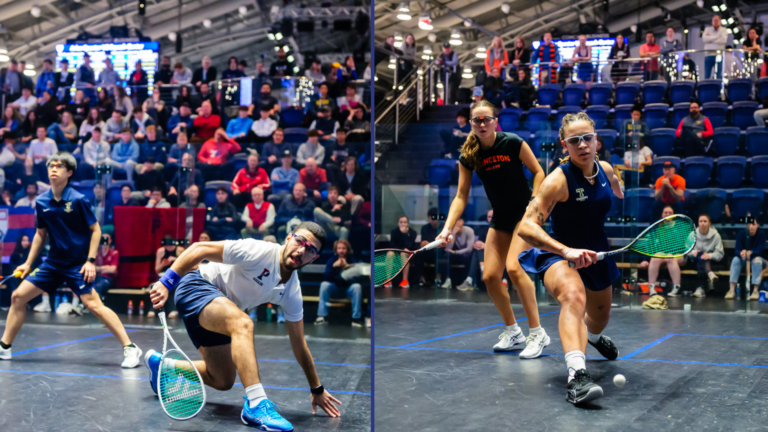
The second half of the college squash season is fully underway, and this weekend promises to deliver some of the most exciting and consequential matches of the year. With 53 matches scheduled, the weekend is packed with action across all divisions, and the outcomes will have significant implications as we march closer to the National Team Championships.

This weekend features a packed slate of marquee matchups and tightly contested battles across the rankings, making it one of the most significant weekends of the season. At the top, several key showdowns between top 10 teams on both the men’s and women’s sides will take center stage. Matches like Cornell vs. Dartmouth, Princeton vs. Yale, Columbia vs. Harvard, and Penn vs. Trinity will not only showcase the best teams in the country but also play a crucial role in shaping the upper rankings as we move toward the National Team Championships.

Beyond the top 10, the weekend is filled with matchups featuring teams separated by just a few ranking positions, such as Navy vs. Amherst and F&M vs. Williams on the men’s side, and Georgetown taking on Amherst, Middlebury, and Williams on the women’s side. These tightly contested matches are critical for teams vying to improve their rankings and secure a place in the championships, offering plenty of opportunities for upsets and shakeups across the board.

Every match at this stage of the season carries heightened significance. The results will play a vital role in determining which teams qualify for the National Team Championships and their seeding positions. In addition, key individual matchups within these team contests will offer a glimpse of what’s to come at the Individual Championships in NYC at the end of January. These head-to-head battles will help shape the selection and seeding for one of the season’s most anticipated events.

With so much at stake, this weekend is a pivotal moment in the college squash season. Fans can expect intense competition, dramatic finishes, and a clearer picture of the road to the championships. Stay tuned for updates as the action unfolds!

You can view and follow the upcoming matches for Week 6 (January 8 to January 15) below:


Match of the Week

Women

No. 4 Princeton University vs. No. 2 Trinity College

A blockbuster showdown awaits this Sunday, January 12, at 12:00 p.m., as the #4-ranked Princeton Tigers host the #2-ranked Trinity Bantams in Princeton, NJ. This highly anticipated rematch of last season’s CSA National Team Championships final, where Trinity claimed the Howe Cup title, is shaping up to be the biggest women’s match of the season so far.

Both teams are incredibly evenly matched, showcasing the depth and competitiveness at the top of the women’s rankings. Trinity, the reigning national champions, are led by new head coach Lauren Patrizio and enter with the upper hand in the rankings. Meanwhile, Princeton’s impressive team, led by veteran coach Gail Ramsay, who has guided the Tigers for over 30 years, is determined to avenge last year’s loss and make a statement on their home courts.

With a storied history of tightly contested matches between these powerhouse programs, this Ivy-NESCAC clash promises thrilling squash action and major implications for the rest of the season.

Men

No. 1 University of Pennsylvania vs. No. 2 Yale University

The top two men’s college squash teams in the nation will collide this Sunday, January 12, at 12:00 p.m. as the reigning national champion and #1-ranked University of Pennsylvania Quakers host the #2-ranked Yale Bulldogs in Philadelphia. This Ivy League showdown promises to be one of the most exciting matches of the season.

Both teams face challenging matches on Saturday, making this clash a true test of depth and endurance. UPenn enters the match as the team to beat, while Yale, boasting a formidable roster, will look to shake up the rankings with a statement victory.

With key individual matchups on the docket, the implications extend beyond team rankings, offering a preview of potential battles at the Individual Championships. This storied rivalry is set to deliver an electrifying start to the second half of the season. Don’t miss it!

The order of play for Week 6 (January 8-15) is as follows:

3-Court System
1,3,2 / 5,6,4 / 7,8,9

5-Court System
1,2 / 4,3 / 5,6 / 7,8 / 10,9

You can view all past results from the 2024-25 CSA season here:

Week 5 Recap: January 2 to 8 – Highlights from College Squash

Photo credit: Josh McKee/Hamilton College

College squash returned to action last week following the winter holidays, with Week 5 marking the start of the second half of the season. It was a slower restart, with only 13 matches played between January 2-8, but the competition delivered plenty of excitement. The schedule was largely dominated by NESCAC teams, with additional action from Navy vs. Western Ontario and St. Lawrence vs. Hobart and William Smith.

Close matches were a theme of the week, highlighted by Amherst men securing a narrow 5-4 victory over Bowdoin and Hamilton women edging Conn College 6-3. Connecticut College men pulled off the sole upset of the week, defeating Hamilton 5-4 in a hard-fought match. The St. Lawrence women also logged a strong 6-3 win over William Smith.

As teams shake off the winter break and return to form, fans can look forward to an exciting stretch of college squash in the coming weeks as the race to the championships heats up!

Matches of the Week 

Women
No. 18 Bowdoin College defeats No. 19 Wesleyan University
Read More…

Men
No. 29 Connecticut College defeats No. 25 Hamilton College
Read More…

A full list of results can be found here: Men’s Results & Women’s Results.

CSA Men’s Match of the Week: Connecticut College Edges Hamilton in Thrilling 5-4 Battle

In a closely contested NESCAC rivalry, #29 Connecticut College secured a hard-fought 5-4 victory over #25 Hamilton College in this week’s CSA Men’s Match of the Week. The match, held on Wednesday, January 8, at Hamilton’s home courts in Clinton, New York, featured high-stakes competition as both teams looked to make their mark in the conference rankings.

The opening matches set the stage for a dramatic contest. Connecticut’s Alejandro Moncada Gonzalez (#1) earned an early win in three games, while Hamilton’s Cooper Jessop (#6) responded with a dominant three-game victory. The standout performance of the first round came from Oliver Machiels (#9) of Conn College, who battled through five grueling games, clinching an 11-13 win in the fifth to give his team an early advantage.

The second round of matches continued the excitement. Siddhant Rewari (#5) gave Connecticut an important win with a dominant straight-games performance. Jacob Stoffman (#8) delivered a crucial point for Hamilton, keeping his team in the match with a well-earned four-game victory. Hudson Dunn (#2) then capped off the round for Connecticut, staging a thrilling five-game comeback after trailing 2-1 to extend Conn’s lead to 4-2.

The final round featured an electrifying finish as Hamilton needed to win all three remaining matches to complete the comeback. Simon Muller (#7) was the first to finish, delivering a three-game sweep to narrow the gap to 4-3. Meanwhile, matches featuring Henry Pelletier (#3) for Connecticut and Jacob Shulman (#4) for Hamilton unfolded simultaneously, with both players delivering strong performances under immense pressure. Shulman won a hard-fought five-game match, while Pelletier clinched the decisive fifth point for Connecticut with a composed four-game victory. The near-simultaneous finishes provided a dramatic conclusion to the closely contested match.

Connecticut College Head Coach Tim Lasusa praised his team’s resilience. “Going into the match we knew it was going to be a battle,” he said. “We’ve had some tough matches so far this year, with us losing some tight ones, so for us to get the result was great. A couple key things have started to come together, so hopefully we can keep the momentum going and get geared up for some more tough matches ahead.”

Key performances for Connecticut included Hudson Dunn and Oliver Machiels, both of whom came from 2-1 down to win in five games, showcasing grit and determination under pressure.

Connecticut College will look to build on this momentum as they continue their NESCAC schedule.

CSA Women’s Match of the Week: Bowdoin Secures Hard-Fought Victory

In a highly anticipated matchup between two closely ranked NESCAC teams, #18 Bowdoin College earns an impressive 8-1 victory over #19 Wesleyan University in this week’s CSA Women’s Match of the Week. The contest, held on Tuesday, January 7, in Middletown, Connecticut, added another chapter to the storied rivalry that has spanned nearly five decades. Despite the scoreline, several matches came down to the wire, showcasing the competitive spirit on both sides.

Bowdoin set the tone early in the first round of matches. Emma Kate Watts-Roy securing a four-game win at #1 and freshman Amelie Matuch taking a decisive three-game victory at #6. The standout performance in the opening round came from Elizabeth Kennedy, another freshman, who battled through five tight games to clinch the win at #9, giving Bowdoin a 3-0 lead.

In the second round, Bowdoin continued their strong momentum. Amanda Cowhey prevailed in four games at #2, and Kira Gwadry swept her opponent in three games at #5 to clinch the match for Bowdoin. Wesleyan’s lone victory came from Portia Pliam, who displayed grit and determination in a five-game thriller at #8.

Although the team result already decided, the final round of matches still brought excitement and high-level squash. Bowdoin added three more wins, with Darcy Weber earning a four-game victory at #3 and Clare Collins and Linley Grosman each claiming three-game wins at #4 and #7, respectively.

Bowdoin Head Coach Brendan McClintick praised his team’s depth and poise. “When you go to play Wesleyan, you know you’re going to face a consistent and deep team every year,” McClintick said. “For me, the start we had really set the tone. Our first three on—Emma Watts-Roy (senior), Amelie Matuch (freshman), and Ellie Kennedy (freshman)—pulled through with important wins. I am extremely proud of the maturity they all displayed as they played patient and measured squash.”

McClintick highlighted the contributions of Bowdoin’s freshman class, who were instrumental in securing the victory. “Our freshman class really made big moves,” he added. “It really is a special group of young women who know the value of supporting each other in their pursuit of excellence.”

The Polar Bears now turn their attention to upcoming matches against William Smith and St. Lawrence, followed by a trio of exciting NESCAC matchups at home. Meanwhile, Wesleyan will regroup as they prepare for the challenges ahead in the competitive NESCAC landscape.

Character, Career, Community: Zerline Goodman

For Zerline Goodman, squash has always been about more than competition. A three-time All-Ivy performer during the early 1980s and later a top-30 PSA player, Goodman’s journey through squash has been a bridge to family, a source of lifelong values, and a wellspring of gratitude that fuels her profound desire to repay a game that has enriched her life.

Goodman, Yale Class of 1984, began her collegiate squash career at Trinity College before transferring to Yale, where she played No. 1 for the Bulldogs throughout her sophomore, junior, and senior years. Her defining moment came during the 1982-83 season when she secured the deciding match in Yale’s dramatic 5-4 victory over Princeton, clinching Ivy League supremacy. Yet, beyond the accolades and victories, Goodman treasures the sense of purpose and focus the sport instilled in her—qualities that have guided her as a mother, a lawyer, and a committed advocate for squash.

Family has been a cornerstone of Goodman’s squash story. Her love for the game deepened during high school, partly influenced by the tragic loss of her close friend, Cynthia Stanton. This pivotal moment led Goodman to commit to squash fully, setting the stage for her lifelong involvement. She met her future husband, Michael Rothenberg, at the Park Place club in 1989 (they married a year later), and together, they shared a passion for the sport, competing in mixed doubles tournaments and supporting each other’s careers. Rothenberg served as MSRA President, while Goodman balanced her professional life as a real estate attorney with her burgeoning squash career, which included a silver medal at the 1993 Maccabiah Games and the US National 35-and-over title in 2000.

Their shared love for squash extended to their three children, Brice, Garon, and Zaya, who all played on college squash teams (Trinity, Bates, and Bates, respectively). Goodman’s most poignant family squash memory came in 2014 when Brice’s Trinity College team won the Howe Cup. The victory occurred on the second anniversary of Rothenberg’s untimely passing, and the team’s dedication of the championship to his memory was a profoundly moving gesture for Goodman. In gratitude, she created a commemorative poster for the team, underscoring her belief in squash’s power to foster community and connection.

Goodman’s commitment to “repaying the game” has manifested in numerous leadership roles. She served as President of the Skillman Associates (Friends of Yale Squash) for over a decade, chaired the CSA Board of Directors Adjudication Committee, and recently joined the US Squash Board, where she leads the Nominating and Governance Committee. Her dedication has extended to event organization; after recommending Grand Central Terminal to John Nimick as a potential new site for his Tournament of Champions, she directed ticketing for the WPSA Championships and the ToC during its early years in the new venue.

Throughout her career, Goodman has viewed her years playing squash as formative—not just in shaping her as an athlete but in cementing her connection to the sport’s broader community. Driven by a heartfelt appreciation for all squash has brought into her life, Zerline has long sought ways to give back instead of waiting to be asked. From mentoring younger players to supporting institutional growth, her contributions reflect her enduring belief in the value of squash as a force for good.

Zerline Goodman’s legacy is one of dedication, family, and gratitude. Her journey is a testament to the transformative power of sport and the enduring bonds it can create—both on and off the court.

Week 5 Preview: January 2 to January 8

After a well-deserved winter break, College Squash is back in action! While the schedule is relatively light this week with a total of just 13 contests on the docket, the excitement is palpable as teams gear up for the second half of the season.

With the championships just around the corner, every match becomes critical as teams and players sharpen their skills, fight for rankings, and position themselves for a strong finish.

Stay tuned for updates and highlights as the action heats up in the world of College Squash.

You can view the upcoming matches for Week 5 (January 2 to January 8) below:


Match of the Week

Women

No. 19 Wesleyan vs. No 18 Bowdoin

This week’s CSA Women’s Match of the Week features #19 Wesleyan University hosting #18 Bowdoin College on Tuesday, January 7, at 10:00 a.m. in Middletown, Connecticut. This NESCAC rivalry has a rich history, with nearly 50 matchups since their first meeting in 1977.

Last year, Bowdoin edged out Wesleyan in a hard-fought 6-3 battle. With both teams closely ranked and Wesleyan looking to turn the tables on their home courts, fans can expect an exciting and closely contested matchup in this latest chapter of their storied history.

Men

No. 25 Hamilton vs. No 29 Connecticut College

This week’s CSA Men’s Match of the Week features #25 Hamilton College hosting #29 Connecticut College on Wednesday, January 8, at 3:00 p.m. in Clinton, New York. Another exciting NESCAC showdown, this matchup highlights two teams eager to make their mark in the conference rankings.

With the second half of the season underway, every match carries added significance, and this contest is no exception. Hamilton will look to leverage its home court advantage and continue its strong form, while Conn College aims to make a statement against a higher-ranked opponent. Fans can look forward to an exciting and hard-fought battle between these two programs.

The order of play for Week 5 (January 2-8, 2025) is as follows:

3-Court System
1,2,3 / 6,5,4 / 9,8,7

5-Court System
2,1 / 3,4 / 6,5 / 8,7 / 10,9

You can view all past results from the 2024-25 CSA season here:

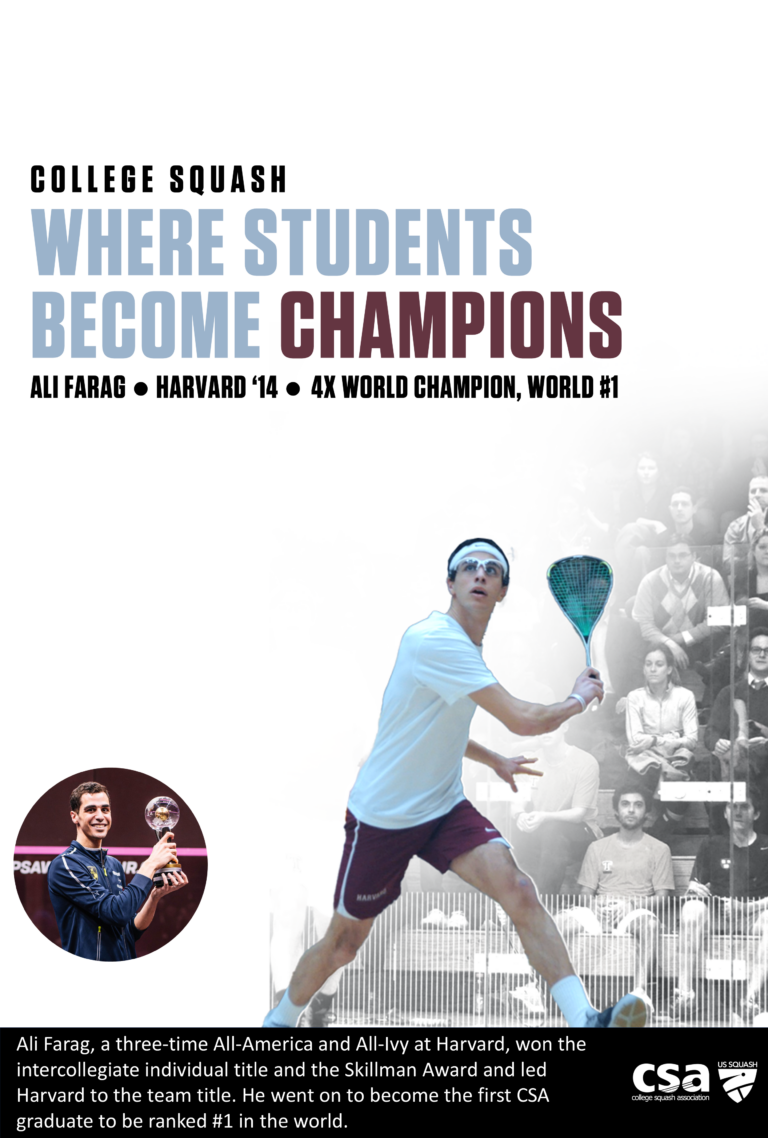
Where Students Become Champions: Ali Farag

by Rob Dinerman, College Squash Historian

It would be extremely challenging to imagine a top-tier PSA squash player who has maintained a stronger continuing connection to his college-years’ squash experience than has been the case with Ali Farag, Harvard Class of 2014, who has been the best squash player in the world over the past half-decade. The four World Open titles (in 2019 and from 2021-23), three U.S. Open championships (in 2017, 2019 and 2024) and three Tournament of Champions crowns (in 2019, 2022 and 2024) that he has won during that time frame are all tops on the Tour with room to spare, as are the 11 major championships he has captured when one includes his run to the winner’s circle in the 2023 British Open, whose final round he attained the four other times that the event has been held from 2019-24.

Although Farag had reached the finals of the 2010 World Junior Open, won the 2011 British Junior Open and led Egypt to victory in the 2010 biennial World Junior Team Championships, he had no wish to go to college in the U.S., opting instead to spend his 2010-11 freshman year contentedly studying at the American University in Cairo. But the Egyptian Revolution, which occurred less than a month after his triumph in England, changed his thinking and he applied and was accepted at Harvard that spring. On the very first weekend of his college career in January 2012, taken aback by the previously-unknown pressure of playing in a team situation, Farag fell behind Princeton star (and the reigning College Individuals champion) Todd Harrity two games to one in a match that Harvard had to have to avoid a team loss. He managed to get through the fourth and fifth games in what he later confessed to Crimson Coach Mike Way had been, to quote Way, “the toughest match of his life. Not just the physical but also the mental part of the fight and the noise of the gallery. I think this weekend he felt the weight and felt that he was carrying the team. So he put a lot of pressure on himself, and when you do that you fatigue prematurely. For Ali, it was like, ‘Welcome to college squash.’ ”

Farag, whom one teammate (accurately) described as “on a different level than anyone else,” went undefeated for the remainder of that season, blazing through the draw of the Individuals tournament without losing a single game, including in the finals against Columbia freshman star Ramit Tandon, a semis winner over Harrity. That spring Farag was named Harvard’s “Male Athlete of the Year” by the school newspaper, The Harvard Crimson, for 2011-12. His undefeated status extended through the 2012-13 dual-meet season, but he suffered postseason losses to both Harrity in the team play-offs and his Egyptian compatriot and contemporary Amr Khalifa in the semifinals of the Individuals. Although those setbacks were extremely painful at the time — all the more so since Harrity had defeated Farag’s older brother Wael a few years earlier in the World Junior Open and Khalifa had been a rival and nemesis throughout their junior careers — both Ali Farag and Coach Way fully believe in retrospect that they were the best thing that could have happened, since they knocked some overconfidence out of him and made him more receptive to coaching and constructive criticism than he had previously been. Both Farag and his teammates — especially his fellow starting-lineup seniors Brandon McLaughlin, Gary Power, Tommy Mullaney and Nigel Koh — completely dominated the 2013-14 season that followed, culminating in a 9-0 thrashing of perennial champion Trinity College in the final round of the national team championship and Farag’s run to the Individuals winner’s circle with a decisive final-round win over Khalifa.

Farag was selected as that year’s recipient of the Skillman Award, the highest individual honor in men’s college squash, “given annually to a senior men’s squash player who has demonstrated outstanding sportsmanship during his entire college career while maintaining a high level of play.” Nobody embodies both criteria for this award more completely than Farag, about whom Mullaney — when asked years later to characterize Farag’s impact on the Harvard program and college squash as a whole — responded, “Ali was the guy who, for all his success and accolades, simultaneously had the grace and humility to go out of his way to sit with visiting friends and family to explain the game so that they felt welcome at matches. I couldn’t imagine a better ambassador for the sport.”

During the graduation ceremony a few months later, Farag received the William J. Bingham Award, “given annually to that male member of the graduating class of Harvard College who, through integrity, courage, leadership and ability on the athletic fields, has best served the high purpose of Harvard as exemplified by the late William J. Bingham ’16, former Director of Athletics. The award goes to our most outstanding male athlete.” Farag was only the third squash player in the award’s 60-year history (also Anil Nayar in ’69 and Adrian Ezra in ’94) to be honored with this distinction. “His legacy is going to go down in history,” Coach Way said upon learning of this honor. “He’s played a brand of squash here that no one has ever seen in our sport. He’s definitely going to live on for the guys who have played alongside him, and also for us as the coaches. As long as we’re in the driver’s seat, we will refer to Ali and how no one respects the game as much as he does—respecting referees, opponents, coaches—that’s part of his legacy.”

Despite Farag’s extraordinary success in junior squash and as a collegian (capping off his intercollegiate career by winning his second Individuals), he had not planned to continue and compete on the PSA tour. A serious student, he had earned a degree in Mechanical Engineering and was going to return to Egypt and embark on a career in that field. But Coach Way and Farag’s then-girlfriend Nour El Tayeb (whom he married in 2016), herself a top-tier player on the PSA women’s tour, encouraged him to give the pro circuit a shot — and the rest is history. Within five years he had become the best squash player in the world, ascending to the No. 1 ranking on the PSA tour with a winter/spring of 2019 surge during which he won the Tournament of Champions at Grand Central Station in midtown Manhattan in January, captured the World Open in Egypt in March and advanced to the finals of the British Open in London in May — and, as noted, he has maintained that level throughout the years that have followed.

Throughout Farag’s unstoppable cascade of accomplishments — which have now reached the point where he fully belongs in the greatest-of-all-time discussion, with plenty of time still to add to his already extraordinary “numbers” — he has continued to rely on Coach Way’s advice and counsel. Coach Way, with characteristic modesty, characterizes his role as more that of a “sounding board” who doesn’t do much more than “wait in the wings,” rather than being an active participant in the process. However, the truth is that he and Farag frequently communicate by text, email and phone, and Way makes an effort to watch Farag’s matches, either in person whenever Farag is playing on the northeastern corridor, or on PSA TV when Farag is playing in a tournament overseas. Coach Way then shares what he observed and constructively criticizes Farag’s performance — very much like what happened while Farag was compiling his 52-2 record during his three years as a Harvard student.

Indeed, when Farag won the 2017 U.S. Open — as did El Tayeb, marking the only time that a husband/wife pairing has ever won a major pro squash tournament at the same time — he was coached by Way throughout his final-round win over Mohamed El Shorbagy, even though the tournament was in Philadelphia and Coach Way was in Cambridge watching the final (along with the rest of Harvard’s men’s and women’s teams) on PSA TV! After every game, while Farag was toweling off and getting a drink of water, he would check his iPhone and read the advice Coach Way had texted him, and in his speech during the trophy presentation Farag gave a shout-out to the Harvard team and the overall Harvard community for conveying their support throughout his run to that championship.

When asked a few years ago to describe Way’s current level of involvement in his career, Farag responded that Way “still is my mentor, and he always will be. We discuss big matches, always. He watches them online, then sends me a lengthy email with his take on the match, then we have a phone call to further discuss it. More importantly, whenever I feel unmotivated, nervous, lost, overexcited, or that any unfavorable sentiment is getting the better of me, he’s my go-to person!” Farag still wears a Harvard crest on his shirt, still has “Harvard College ‘14” embedded in his email signature-line and still makes it a priority to hit with the current Harvard team members whenever he is in the area. In Way’s characterization, “Ali still bleeds Harvard crimson and always will.”

For decades it had been a universally accepted truism that any player who chose to go to university was thereby giving up on a chance to be a successful PSA pro, since it was felt that the player would be sacrificing too many years on the circuit to realistically make up for that lost time once he/she graduates. Farag’s achievements during the decade-plus that has now passed since his Harvard graduation — along with those of Amanda Sobhy, Olivia Weaver (both recently ranked in the top-four of the women’s PSA tour) and the rest of the THIRTY-ONE current or former college varsity players who represented their respective countries in Hong Kong in the 2024 World Team Championships — have emphatically and permanently proven that belief to be completely lacking in merit.

It seems poetically fitting that the men’s event in Hong Kong ended with Farag winning the clinching match over El Shorbagy in Egypt’s final-round triumph against England, which marked the fourth time (previously in 2017, 2019 and 2023) that Egypt has won this event with Farag as a team member. Immediately after winning the final point (on a forehand cross-drop finishing off a frantic front-court exchange), Farag embraced his longtime rival and then scaled the back wall, alighting outside the court to celebrate with his teammates. It was a symbolic top-of-the-world moment for a player who was a classic student-athlete at one of the best colleges in the land and has taken the lessons he learned while in college, both on and off the court, to rise to the top of his profession.

_________________________________________________________________________

Rob Dinerman has written 18 books about squash, five of which are Histories of the sport at various top-tier colleges. All of those books are arrayed on the home page of the robdinerman.com site, including his most recent college-squash book A Century Of Champions: 100 Years Of College Squash, 1923-2013, which was released in March 2024.

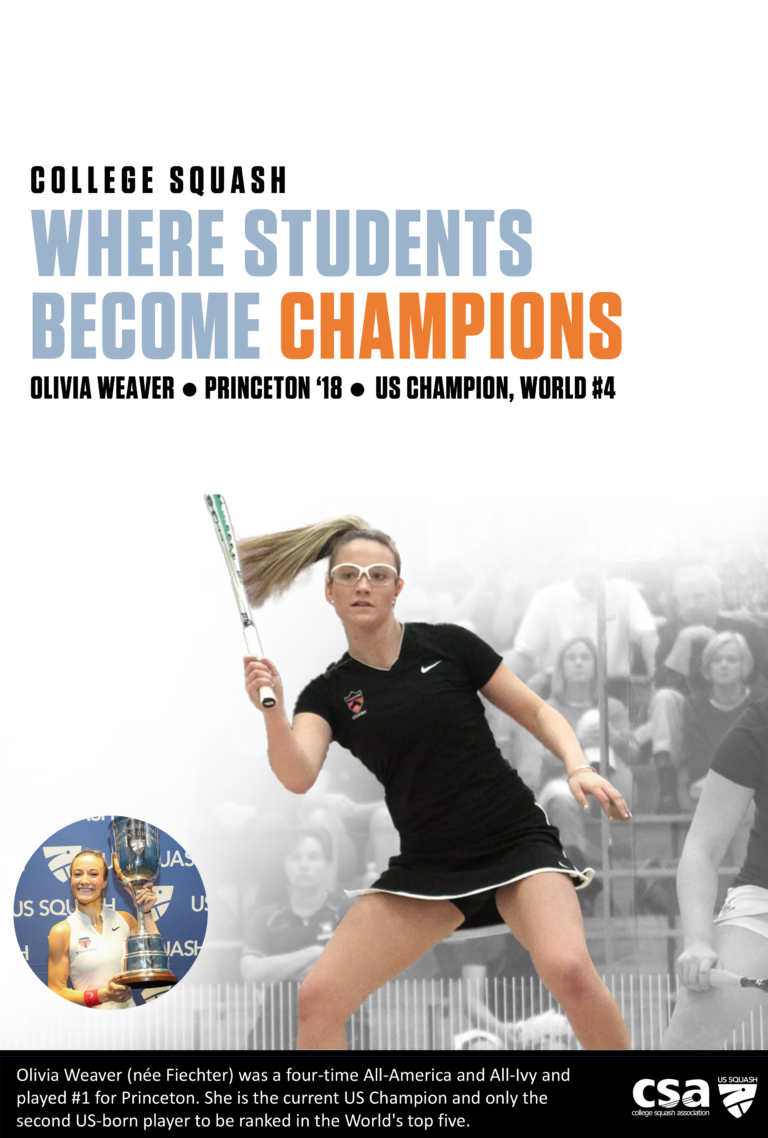
Where Students Become Champions: Olivia Weaver

by Rob Dinerman, College Squash Historian

One of only two American squash players (along with Amanda Sobhy) to attain a top-four PSA ranking, Olivia Weaver (nee Fiechter) has had a consistent and praiseworthy rise through the world rankings in recent years. Her career-best Calendar 2024 performance was highlighted by her winning the U.S. Nationals (after reaching the finals in 2023), the Gaynor Cup and the Silicon Valley Open; reaching the semis of both the U.S. Open and World Open; and playing No. 1 on the U.S. team that earned a silver medal at the World Team Championships in Hong Kong.

After capturing a total of nine U.S. National Junior and Junior Open titles (five in singles and four in doubles) and playing on U.S. Junior teams in international competition every year from 2011-14,  Weaver went on to achieve first-team All-American honors in all four of her years (2014-18) at Princeton, despite the fact that her ability to play at her highest level was severely compromised during both her sophomore and junior years by back injuries — mostly frequent spasms in her left piriformis muscle, causing chronic discomfort and a pinched nerve — that inflamed her entire lower-back area and compromised its ability to fully rotate.  Finally pain-free during her 2017-18 senior season due to a summer-long program of three-times-per-week 5:30am physical therapy sessions while she was working as an intern in Manhattan, Weaver had an excellent winter as the team’s co-captain and No. 1 player, clinching the Tigers’ 5-4 victory over Trinity College with her four-game win over Bantam star Raneem Sharaf and then defeating Harvard’s No. 1 player Sabrina Sobhy, Weaver’s junior-years nemesis, on Sobhy’s turf at the Murr Center in Cambridge.

When asked to identify a single stand-out match or moment in her college career that altered her perception of what possibly lay ahead, Weaver cited that latter victory, her first in nearly a half-dozen years over Sobhy — whom Weaver would also out-play six years later in a dominant 2024 U.S. Nationals final — as having given her a substantial positive nudge forward in terms of her perceived PSA prospects. So did her growing confidence that the back issues, which for years had greatly constrained her ability to train all-out or enjoy the game, had finally been successfully resolved, causing her to feel liberated, free to renew her love for the game and to satisfy her curiosity as to how far she could progress with fully restored health. During that time frame she also received enthusiastic encouragement and support about turning pro from her then-boyfriend/now-husband Bobby Weaver (a Princeton varsity lacrosse player, Class of 2016), as well as from both Princeton’s legendary women’s head coach Gail Ramsay — whom Weaver gratefully acknowledged as her role model and mentor — and the Tiger men’s coach Sean Wilkinson, who, at Weaver’s request, introduced her to Peter Nicol, his longtime friend and a former British Open and World Open champion.

Nicol, whom Weaver met in the spring of 2018 shortly before her graduation, served as Weaver’s primary coach from 2018-23, during the last few years of which she split her time working in New York with him and in her native Philadelphia with former Canadian National Team Coach Graeme Williams. Starting in July 2023, Rodney Martin (like Nicol, a former World Open titlist) became Weaver’s primary coach — the club where he is based in Connecticut is located very close to the home of Bobby Weaver’s family — and his technical expertise and the intensity of the workouts he runs, complemented by the practice sessions she continues to have with Williams when she is in Philadelphia, have made Weaver the fittest she has ever been and added to her racquet weaponry as well.

Weaver’s recent-years accomplishments prior to her banner 2024 results have included winning both the Individual and Team gold medal at the 2023 Pan American Games (where she defeated Amanda Sobhy in the Individual final); her advance to the semis of the U.S. Open in both 2021 and 2023; her membership (as the No. 2 player) on the 2022 U.S. Team that earned silver in that year’s World Team Championships; and the run to the winner’s circle that she and her partner (and former World Open and British Open finalist) Natalie Grainger had in the 2019 Westchester Country Club Open women’s professional doubles tournament.

Weaver feels her Princeton years have significantly contributed to her PSA success on multiple fronts. First, she is convinced that having majored in Anthropology, in addition to making her, in her words, “more aware of cultural differences and a more compassionate and curious person,” has also enabled her to better engage with and respond to the practices and methods espoused by her mental coach, Danny Massaro, who often references philosophers (Sartre and Nietzsche among them) in his approach. In addition, her four years at or near the top of the Tiger lineup provided her with added skills and experience that have played a major role in the extraordinary degree of success that she has subsequently realized. Still in her late 20’s and now well along in her seventh professional season, Olivia Weaver is perfectly positioned to accomplish even greater things in the years leading up to the 2028 Olympic Games in Los Angeles, which has become the ultimate goal of every top-tier player on the PSA Tour.

_________________________________________________________________________

Rob Dinerman has written 18 books about squash, five of which are Histories of the sport at various top-tier colleges. All of those books are arrayed on the home page of the robdinerman.com site, including his most recent college-squash book A Century Of Champions: 100 Years Of College Squash, 1923-2013, which was released in March 2024.

4 Ways to Stay Connected with College Squash During Winter Break

0

With the World Teams just wrapped up and college squash on a short break until January, now is the perfect time to stay engaged with the sport in new ways. Whether you’re a lifelong fan, a current player, or an alum looking to reconnect, we’ve got some great recommendations to help you fill the time and stay connected to the world of college squash.


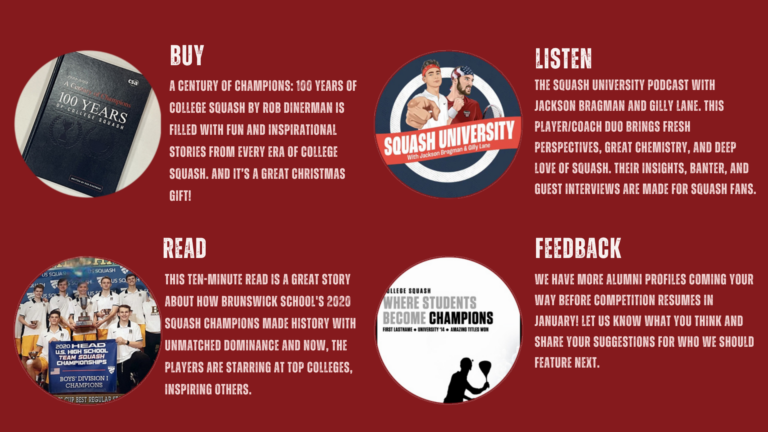
#1: Purchase “A Century of Champions”

A Century of Champions: 100 Years of College Squash by Rob Dinerman is filled with fun and inspirational stories from every era. And it’s a great Christmas gift.

#2: Listen to Squash University Podcast

The Squash University podcast with Jackson Bragman and Gilly Lane. This player/coach duo brings fresh perspectives, great chemistry, and deep love of squash. Their insights, banter, and guest interviews are made for squash fans.

#3: Read about the 2020 Brunswick School Team

This ten-minute read is a great story about how Brunswick School’s 2020 squash championships made history with unmatched dominance–and now, the players are starring at top colleges, inspiring others.

#4: Feedback on Alumni Spotlight Campaign

We have more alumni profiles coning your way before competition resumes in January! Let us know what you think and share your suggestions for who we should feature next.